// service · Assessments
How a detailed OT risk assessment ranks plant work
Zone-by-zone IEC 62443-3-2 detail for loss of view and loss of control. Ranked work a CapEx decision can use. Every finding becomes a Resilion task.
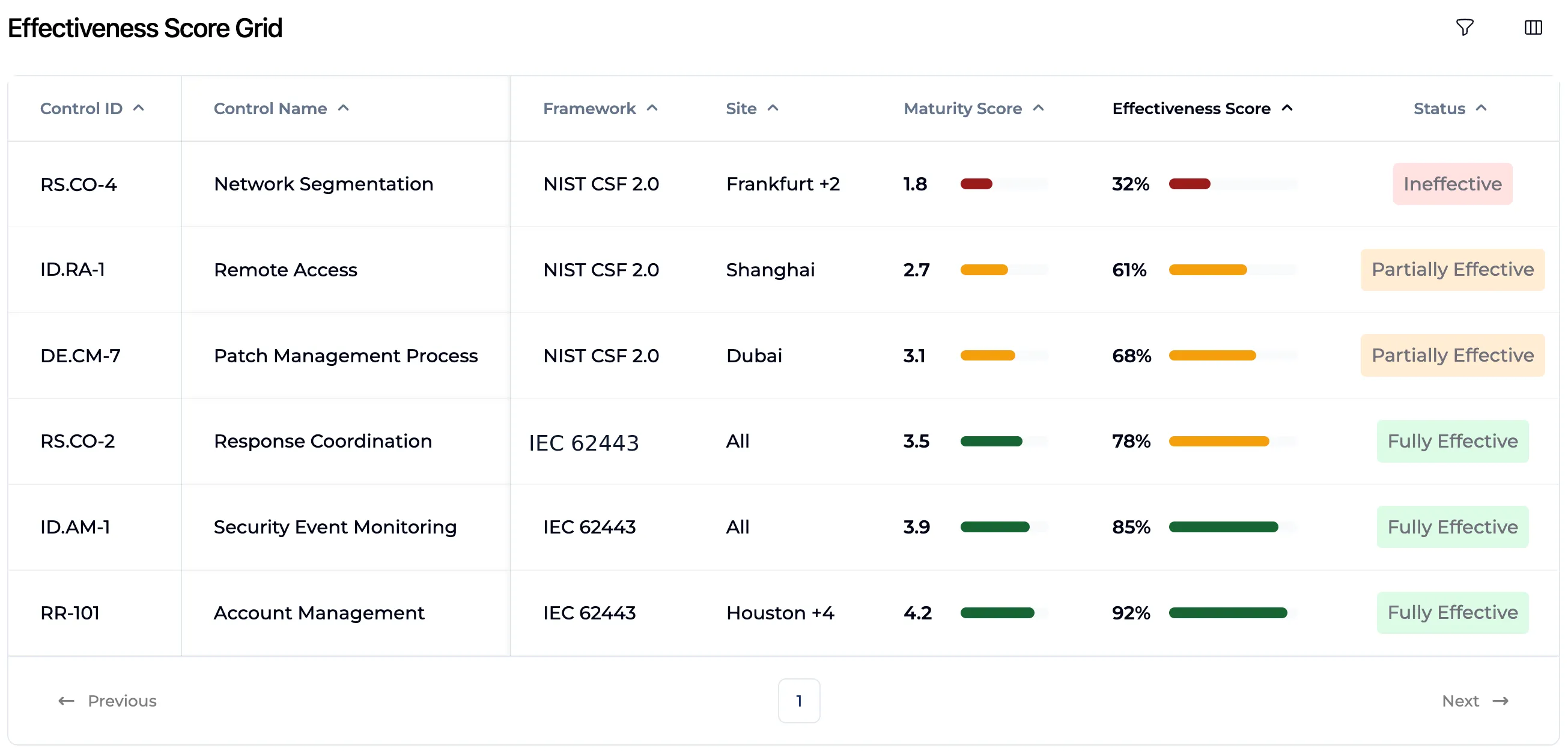
Most plant risk assessments stop at a CVSS list. The report names a hundred vulnerabilities, ranks them by score, and leaves operations no closer to a decision. Loss-of-view and loss-of-control get a paragraph. The remediation roadmap reads like a software backlog the CFO will not fund.
This assessment models risk the way the plant experiences it. We run the IEC 62443-3-2 detailed method zone by zone, build the scenarios that actually threaten production, loss of view, loss of control, safety consequence, and score each by likelihood and impact on the operation, not by CVSS alone.
The deliverable is a defensible, costed remediation roadmap sequenced for your budget cycle, with every finding mapped to a task in Resilion so the work has somewhere to go.
// FAQ
Questions about Detailed OT plant risk assessment
- What does a detailed OT risk assessment cover?
- The full IEC 62443-3-2 detailed method: each zone and conduit assessed against realistic threat scenarios, with loss-of-view and loss-of-control consequences modeled, likelihood and impact scored, and countermeasures mapped to a costed roadmap.
- Why not just use CVSS scores?
- CVSS ranks vulnerabilities in the abstract. A PLC with a CVSS-9 that cannot be reached from the boundary may matter less than a CVSS-5 on a controller that runs a safety-critical line. We rank by production impact so remediation money goes where it changes risk.
- Will the output survive a CapEx review?
- Yes, that is the point. Findings are tied to business consequence and a sequenced, costed roadmap, so finance can fund the plan instead of a list of vulnerabilities.
See this work on your sites
Book a 30-minute demo. Bring the last assessment and the sites in the first wave.