PDF · opens in a new tab
// white paper
Rethinking OT Risk: Operational Resilience Threat Modeling
Challenging the Current OT External Risk Analysis Model
Roger Hill ·
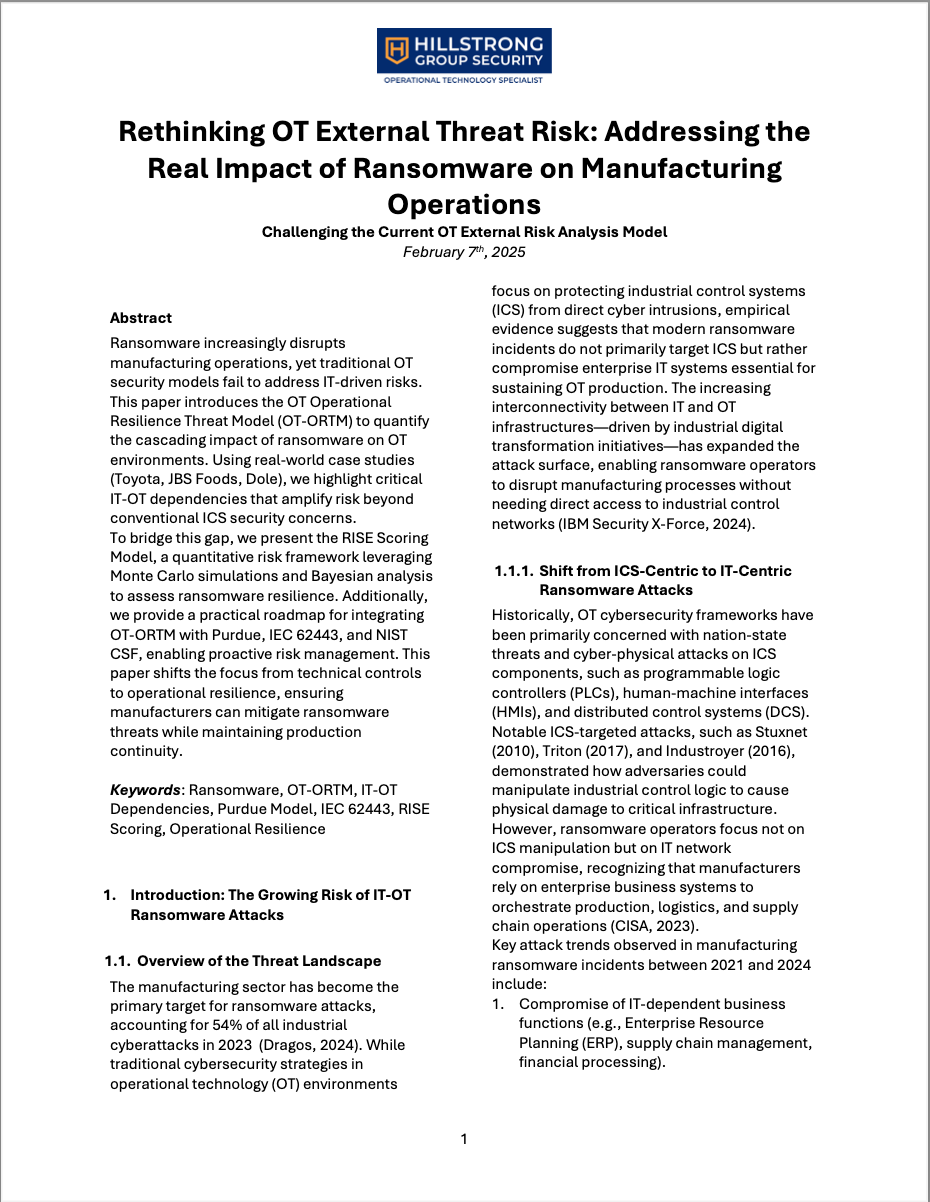
Most manufacturing ransomware never touches a PLC. It encrypts ERP, MES, Active Directory, or a supplier’s order system. The line stops because the business process that feeds it stopped. Purdue, IEC 62443, and NIST CSF still treat the ICS surface as the problem. They do not score that cascade.
OT-ORTM (OT Operational Resilience Threat Modeling) is the method for that job. RISE is the score that ranks which dependencies get fallbacks first.
What the current model misses
ICS-centric history (Stuxnet, Triton, Industroyer) trained the industry to hunt for logic changes on PLCs, HMIs, and DCS. Ransomware operators go where the plant cannot run without: order entry, raw-material procurement, production scheduling, payroll clocks, vendor payments.
Purdue (ISA-95) isolates Levels 0-3 from 4-5. That is still useful segmentation. It does not tell you what happens when Level 4 dies and Level 2 is fine. IEC 62443 and NIST CSF 2.0 give you zoning, SLs, and Govern. They do not quantify IT-originated production loss.
Four phases
1. Identify IT-OT business-process dependencies. Inventory the enterprise systems production cannot run without. ERP for procurement. MES for scheduling. Workforce systems for clocks. Finance for vendor payments. Classify by how fast the line stops if that system is gone.
2. Map attack paths through those dependencies. Phishing into ERP admins. A supplier’s IT. Cloud MES. Lateral movement that takes Active Directory. The 2022 Toyota supplier case is the pattern: ERP at a parts vendor, 14 plants down, no ICS compromise.
3. Score with RISE. Risk exposure (R) 30%. Impact on production (I) 30%. Speed of recovery (S) 20%. Effort to mitigate (E) 20%.
RISE score = (R × 0.3) + (I × 0.3) + (S × 0.2) + (E × 0.2)
The paper applies that to JBS Foods 2021 and lands 8.3 / 10 (high risk). Use the number to rank work, not to decorate a slide.
4. Test resilience against the high scores. Offline or degraded ERP/MES. Manual line operation if IT is gone. Vendor contingencies when a supplier’s IT dies. Then exercise those paths.
Cases the model is built on
Bassett Furniture, MKS Instruments, JBS Foods, Toyota, Dole. Same shape: IT or supplier IT fails, OT output stops, ICS stays up. Colonial Pipeline is the cousin in energy: IT hit, OT shutdown by decision, not by PLC payload.
If you need the assessment that walks a site through this, use the OT ransomware readiness assessment. Manufacturing is the industry landing. RiskSpan covers the IT/OT boundary the cascade crosses.
The PDF has the decision trees, worked RISE tables, and the 62443/CSF map. This page is the citable argument.