The OT Risk the CFO Can’t See
Hillstrong Group Security ·
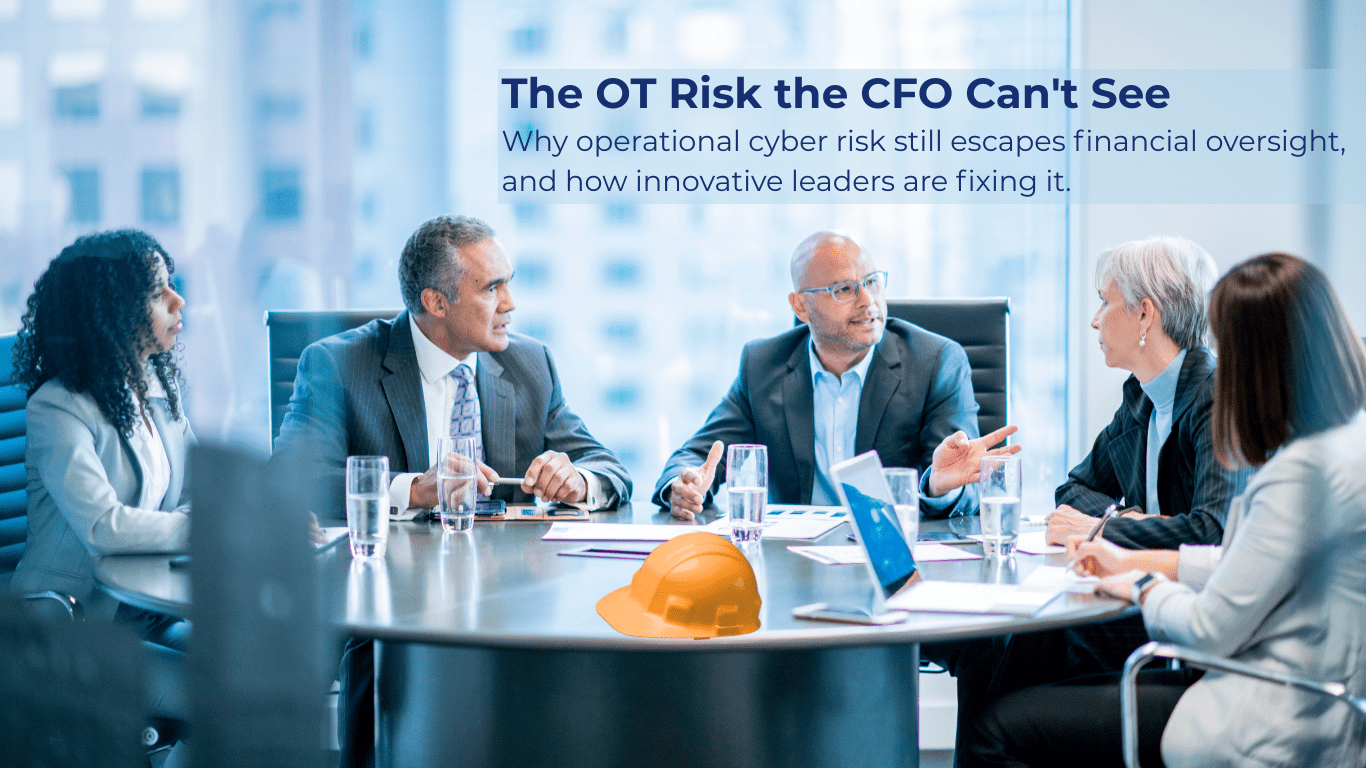
Why operational cyber risk still escapes financial oversight—and how innovative leaders are fixing it.
Author: Roger Hill
“What gets reported gets funded. And if your OT risks aren’t reported in business terms, they don’t exist at the executive table.”
If your CFO asked for your top 3 OT cyber risks, could you answer in dollars?
There’s a silent disconnect in boardrooms today. While enterprise leaders obsess over ransomware headlines, OT security teams are fighting a different kind of war—and losing budget battles they never got to join.
Why? Because the language of OT risk still doesn’t translate into the language of executive action. We don’t have a visibility problem. We have a framing problem.
The Problem We’re Not Talking About
OT risk rarely appears on the enterprise risk register. It doesn’t align neatly with traditional IT metrics and often lacks the storytelling power needed to win airtime in executive discussions.
The metrics we use are operational, not strategic:
- Patching stats
- Scan counts
- Asset uptime
None tells a CFO what an unpatched PLC might cost in lost production.
None of it tells the board how vendor credential drift could trigger a compliance failure and spike insurance premiums.
So OT teams report to CISOs, who report to CIOs – who don’t own the asset producing the revenue.
And that means the risk, while very real, never enters financial planning conversations.
This misalignment limits visibility, weakens OT’s ability to secure funding, prioritize investments, and establish a business case for modernization, and turns legitimate concerns into what the board perceives as “technical noise.”
When OT Risk Finally Got Noticed
We worked with a multi-site industrial client who completed all the right paperwork. Their GRC program was mature on paper: policies were reviewed, risk matrices were defined, and exception logs were diligently maintained.
However, the badge system hadn’t been audited in one of their highest-throughput plants in 14 months. A long-tenured contractor still had physical access, despite their contract expiring three quarters earlier. That same credential was used to plug a laptop directly into an unmanaged switch on the process control network.
The result? Not malware, not espionage, but a manual system override during peak operations, which forced a halt to ensure personnel safety. The downtime ripple effect spanned four sites and delayed customer shipments across two continents.
Impact: $3.1 million in late penalties and expedited logistics costs.
The CFO didn’t get that story from a vulnerability scanner.
They understood when the supply chain director asked, “Why are we eating costs to make up for a plant error?”
That’s when the risk got noticed.
Why Technical Metrics Aren’t Enough
Most OT cybersecurity reports resemble a service log: vulnerabilities discovered, patches deployed, devices scanned, risks accepted. They’re often detailed, but not decision-ready.
CFOs and COOs don’t operate from that lens. They look for exposure, trends, investment justification, and revenue impact. When OT cybersecurity conversations fail to cross that divide, funding dries up.
That’s why reporting tools aren’t the solution – translation is.
What does this control gap mean in terms of uptime exposure? What’s the estimated cost of delaying this upgrade? Which sites are most likely to trigger fines or lost contracts?
Boards don’t care how many devices have been scanned. They care about what happens when one of them fails in production.
What Smart Organizations Are Doing Differently
They’re changing the conversation.
Instead of reporting activities, they’re telling stories of exposure and consequence:
- What happens if this site goes offline?
- What’s the cost of a failed audit?
- Where is our coverage weakest?
They’re moving from site-by-site spreadsheets to comparative frameworks that allow them to prioritize by risk tier and impact.
They’re incorporating business stakeholders into risk reviews—creating accountability across disciplines. Cybersecurity isn’t siloed as “IT” or “compliance” anymore; it becomes part of how the company talks about operational resilience.
Some organizations are even embedding OT cyber metrics into enterprise KPIs and executive dashboards—not as a separate track but as part of business continuity, revenue protection, and audit readiness.
Because when OT risk is translated into business language, it finally earns a seat at the table.
What You Can Do This Week
If you’re an OT leader:
- Stop reporting vulnerabilities.
- Start reporting exposure.
- Connect system health to operational consequences.
If you’re a CISO or GRC lead:
- Don’t assume the board understands OT risk.
- Quantify it regarding operational downtime, compliance impact, and financial exposure.
- Establish a recurring executive briefing cadence.
If you’re a CFO or COO:
- Ask your teams to bring you their top 3 OT risks – in business terms.
- If no one brings you a number, you don’t have a handle on the risk, just a hope.
You can’t manage what you don’t understand. And you can’t fund what you don’t see.
A Final Thought
Operational risk is a board-level issue hiding in plain sight. It shows up after the event but lives upstream: in ignored exceptions, outdated inventories, and risk reports that speak the wrong language.
The question isn’t whether OT cyber risk matters. Why hasn’t it been included in the financial playbook yet?
It’s time it did.
Your Turn
What would it take for OT cyber risk to earn a seat at your next board meeting?
Let’s move the conversation forward.
Thanks for reading! Follow us on LinkedIn for more! Be on the lookout for our weekly OT cyber blog series, upcoming eBook and webinar announcements.